


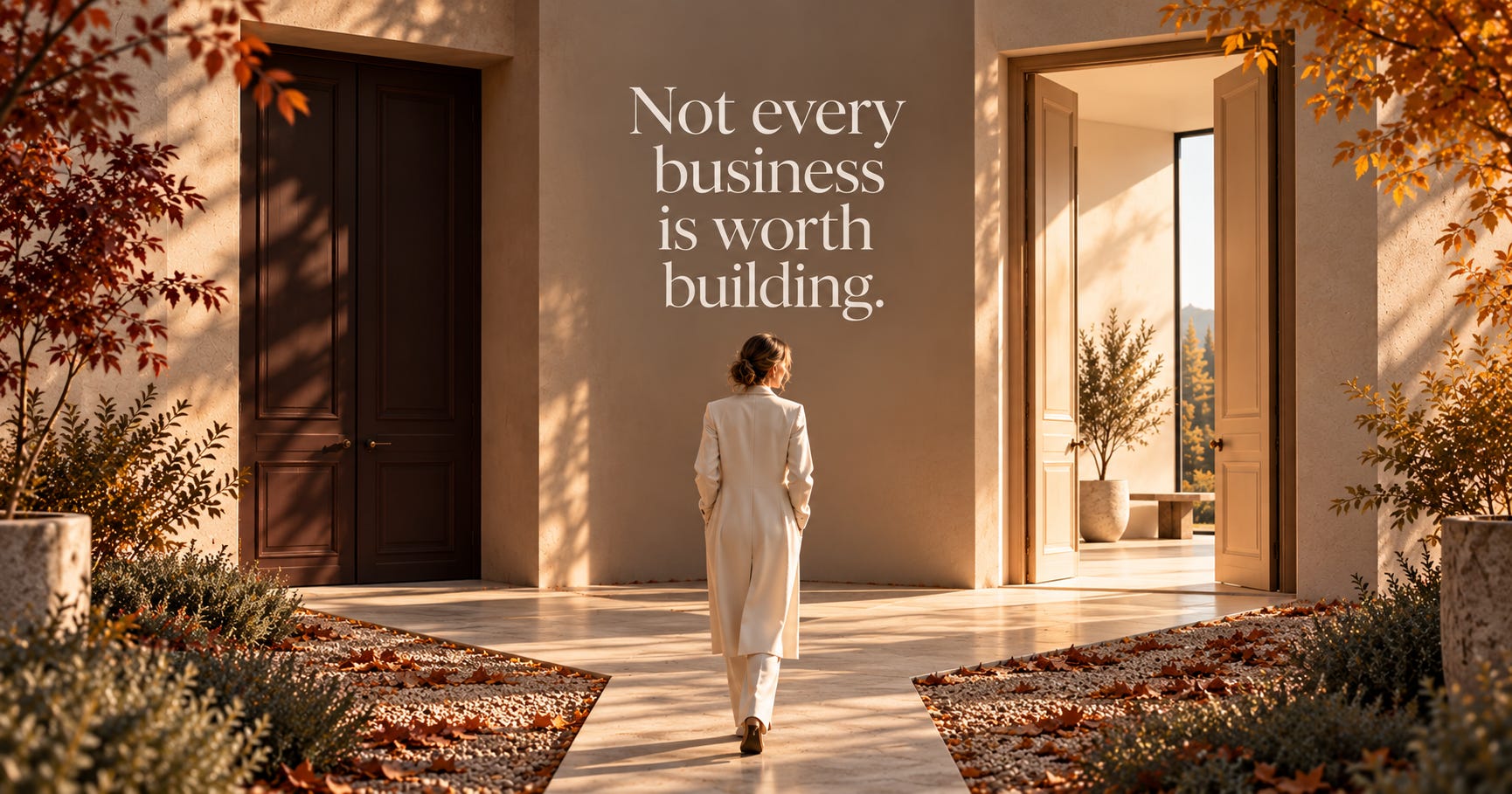
You can leave a demanding career behind and still build yourself another demanding job. The difference begins with the decisions you make before you start.
There is something wonderfully exciting about deciding to build a business of your own. Particularly when you’ve spent decades working within organisations, making decisions, solving problems and delivering results for someone else.
You begin to imagine the possibilities. Working on your own terms. Choosing your clients. Deciding what deserves your time. Having more control over your income and how you spend your days.
And then, almost without noticing, you begin designing a business around everything you know how to do.
You look at your experience and start considering all the different ways someone might pay you for it. It’s a perfectly understandable place to begin.
But I think there’s a more important question to answer first.
What kind of business do you actually want to own?
Because being qualified to deliver a service and wanting to build a business around delivering that service are two very different things.
Your Experience Is an Asset. It Isn’t Your Business Model.
The problem begins when you confuse what you’re capable of delivering with what you actually want your working life to look like.
If you’ve spent years being the person everyone calls when something needs sorting out, do you really want to build a business where clients pay you to remain that person?
Perhaps you do. Perhaps you love the work and simply want to do it independently.
But perhaps the whole reason you’re considering a business is that you want a different relationship with your time, your responsibilities and your income.
Those are not minor details to consider later.
They belong at the very beginning.
Decide What You Want Your Business to Give You
Before you choose your offer, I would ask you to make four decisions.
Not about your website, your logo or what to call yourself.
About the business itself.
1. How much of your time are you willing to sell?
A service business can be an excellent way to begin earning independently. It allows you to work directly with clients, understand their problems and get paid for your expertise.
But there’s an important distinction between owning your business and owning your time.
If every dollar you earn requires another hour of your personal involvement, you’ve created a business with a clear capacity limit.
That isn’t automatically a bad thing.
It becomes a problem when your reason for leaving your previous career was to have more freedom, yet your new income depends on keeping your calendar full.
Decide how much direct client work you actually want to do.
And be honest about whether you want to spend the next five years doing it.
2. What income does the business need to produce?
I hear people talk about wanting a successful business without defining what success means financially.
But the number matters.
A business designed to generate an additional $2,000 a month looks very different from one intended to replace a senior executive salary.
The pricing, the number of clients, the delivery model and the way you attract customers all need to support that ambition.
And revenue isn’t the same as personal income. The business has costs, taxes and periods when sales are slower.
Start with the amount you want the business to provide for you, then work backwards.
Not because money is the only measure of success.
Because financial independence becomes rather difficult when we refuse to discuss the finances.
3. How much responsibility do you want to carry?
This is one of the questions I find particularly interesting.
Many accomplished women have spent years carrying enormous responsibility. People, budgets, deadlines, performance, expectations and the endless decisions that come with them.
When they start their own businesses, they sometimes recreate that same structure without meaning to.
They build teams before they need them. Introduce multiple services. Accept complicated client arrangements. Make themselves available for every question.
And before long, the business that was supposed to create independence begins demanding the same kind of attention as the career they wanted to leave.
You don’t need to build a large organisation to build a valuable business.
You need to build one that makes sense for your ambitions.
4. What do you want to be doing three years from now?
This question changes the conversation.
If you want to spend your days working closely with clients, build around that.
If you want to teach, create, write or develop intellectual property, explore a model that makes those activities central.
If you want a business that can eventually generate revenue without your direct involvement in every transaction, that needs to influence what you create from the beginning.
None of these models is inherently superior.
But they lead to very different working lives.
And that’s precisely why you need to choose deliberately.
Don’t Build Everything You Know How to Build
One of the advantages of starting a business later in your career is that you’re not short of options.
One of the disadvantages is that you’re not short of options.
You can see opportunities everywhere because you’ve accumulated the knowledge to recognise them.
You can easily convince yourself that offering more will make your business more attractive.
I would argue the opposite. At least in the beginning.
The more different problems you promise to solve, the harder it becomes for someone to understand exactly why they should come to you.
And the more different ways you deliver your expertise, the more complicated your business becomes to operate.
Start with one clearly defined problem for a specific group of people.
Develop an offer that solves it.
Find out whether people are willing to pay for that solution.
Then learn from what happens.
You can expand later. You don’t need to build the entire business before you’ve made your first sale.
Build Around the Life You Want, Not the Career You Had
When I began developing my own business, I knew one thing very clearly.
I didn’t want to recreate the working life I’d already had.
I have enormous respect for the experience I’ve accumulated, and I intend to use it. But I don’t want every opportunity to earn money to depend on me personally being available to deliver another service.
That has influenced the decisions I’m making about my own business.
I’m interested in creating practical tools, workshops and programmes that allow me to share what I’ve learned in ways that are useful to other women, while gradually building a business that isn’t entirely dependent on selling my time.
I’m still building it. Still testing what works. Still learning what people need and what they’re willing to pay for.
And I’m very aware that having a clear idea of the business you want doesn’t mean you’ve already built it.
But it does mean you have something against which to evaluate your decisions.
When a new opportunity appears, you can ask whether it moves you towards that business or simply gives you another way to stay busy.
That distinction matters.
Because after years of working, I don’t believe the objective is simply to prove that we can still do more.
We’ve already proved that.
The opportunity now is to decide what deserves the benefit of everything we’ve learned.
Your First Business Decision
If you’re considering turning your experience into an independent income stream, don’t begin by listing every service you could offer.
Begin with a blank page and answer these questions:
How much income do I want this business to generate?
How many hours a week do I want to work?
What kind of work do I genuinely want to spend those hours doing?
What responsibilities am I no longer willing to carry?
Does the business I’m considering actually support those answers?
Then look at your experience and decide how to put it to work.
You don’t need to have every detail figured out before you begin.
But you do need to understand what you’re trying to build.
Otherwise, you risk spending the next few years becoming exceptionally good at a business you never really wanted.
And after everything you’ve already accomplished, that would be a rather expensive way to discover you made the wrong decision.
An invitation
On Thursday, 12th of November 2026, I’m hosting a small, live Second Act Blueprint Workshop for women who want to explore how their professional experience can become the foundation of a business of their own.
We’ll work through the early decisions together, including the experience you want to use, the problems you’re equipped to solve and the direction you want your business to take.
It’s a two-hour online workshop, limited to 6–8 women, so there’s room to think, ask questions and work through your ideas.
For this first workshop, I’m offering an introductory price of $129, including The Second Act Blueprint. Future workshops are planned at $195.
Registration opens shortly. If you’d like to be among the first to receive the details, simply reply to this email with Workshop, and I’ll be in touch.
